
This whitepaper provides a complete ecosystem framework for building predictable, scalable, and profitable customer traffic for indoor go-kart centers in 2025. It is designed for both new investors and existing operators who want to move beyond traditional marketing methods and build a true entertainment business engine.
1. Why Most Indoor Go-Kart Centers Struggle to Grow
Most go-kart centers do not lack potential. They lack a sustainable traffic system. This is why many centers experience the same cycle:
- Grand opening → high curiosity traffic
- Month 3–6 → traffic drops
- Month 6+ → unstable revenue, slow payback
This happens because operators rely on:
- Mall walk-ins
- Basic social media posting
- Occasional holiday events
- Discounts during slow weeks
None of these strategies create repeatable, compounding traffic growth.
The real problem is that most go-kart operators treat the venue as a “ride,” not a multi-engine business ecosystem.
A successful 2025 go-kart center runs on:
- Traffic Engine – diversified customer acquisition
- Experience Engine – emotional, memorable, and viral-friendly racing
- Monetization Engine – maximize revenue per customer
- Retention Engine – create racing habits and repeat visits
- Expansion Engine – grow beyond ticket sales into MR, bundles, events
When all five engines operate together, the business enters a state of predictable growth and fast ROI.
2. The Modern Go-Kart Business Architecture
Indoor go-karting in 2025 is no longer a simple amusement activity. It is part of a fast-growing FEC (Family Entertainment Center) ecosystem. Understanding your business architecture is the first step in building a scalable traffic strategy.
The Five Engines of a Modern Go-Kart Center
1) Traffic Engine
The collection of all channels that bring first-time visitors—digital channels, partnerships, influencers, mall foot traffic, events, and more.
2) Experience Engine
Everything that happens in your venue—from check-in to race results. Lighting, track layout, equipment, music, atmosphere, and staff service all shape customer emotion.
3) Monetization Engine
How each visitor turns into revenue: tickets, upsells, memberships, bundles, MR add-ons, birthday rooms, corporate events.
4) Retention Engine
The system that keeps customers coming back: lap-time challenges, loyalty points, “race again” discounts, member leaderboards, tournaments.
5) Expansion Engine
New revenue streams: children’s tracks, VR rooms, arcade zones, party rooms, MR racing, food & beverage, merchandise.
Strong centers integrate all five engines into a single growth system. Weak centers rely only on the first engine.
3. Strategic Positioning Map: Choose Your Model
Your positioning determines your customer profile, your pricing, your marketing channels, and even your experience design. Most failing tracks fail because they try to be “for everyone.”
Successful go-kart businesses choose one of five core positioning strategies:
1) Family Entertainment Model
Strong daytime traffic, high birthday-party revenue, repeat weekend visits. Works well with 350–600㎡ tracks.
2) Competition / Speed Model
Targets teens and young adults who enjoy repeated racing and improvement. Works best with 450–900㎡ tracks.
3) MR/VR Tech Experience Model
Highly viral, visually impressive, premium pricing. Top choice for modern malls and tech-friendly markets.
4) Social Hangout Model
Focuses on lighting, music, atmosphere, and Instagram/TikTok shareability. Excellent for teens and weekend crowds.
5) Corporate Events & Team-Building Model
Premium bookings with high margins, especially during weekdays. Works best in cities with strong business districts.
A clear positioning allows you to dominate your chosen customer segment rather than compete on price.
4. Consumer Psychology Behind Go-Karting
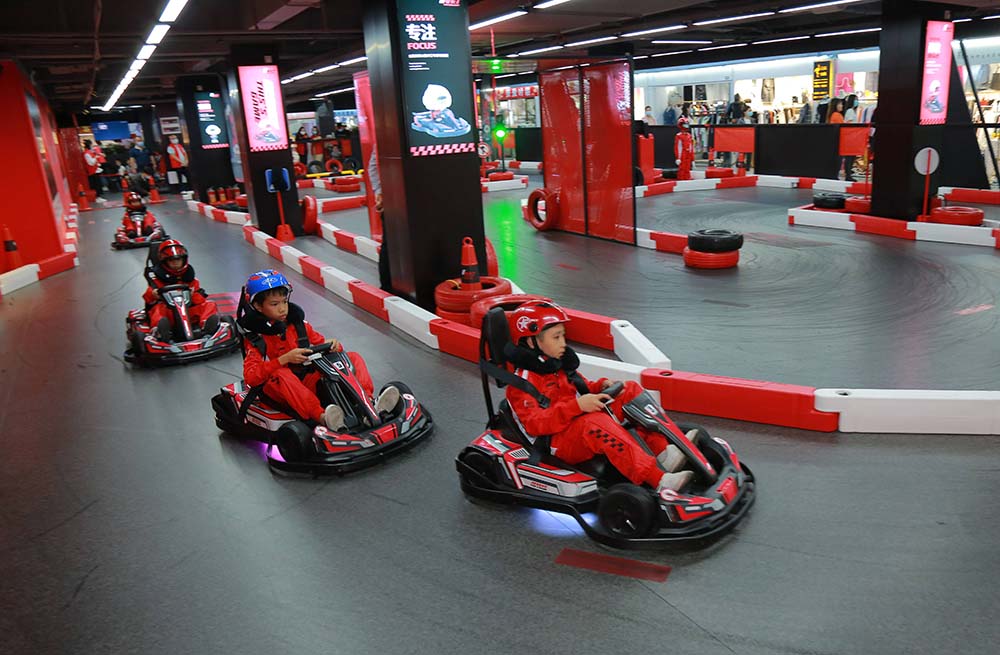
Traffic growth becomes significantly easier when your venue aligns with the emotional needs of your customers. Go-karting appeals to universal human motivations:
1) Thrill and Adrenaline
People want excitement that is safe yet intense. This is why the first acceleration moment is crucial.
2) Competitiveness
Lap time improvement triggers dopamine. This is what makes customers return again and again.
3) Social Proof
Teens and young adults go where others are going. A crowded, energetic track attracts more traffic.
4) Fantasy Fulfillment
People want to feel like real racers—timing systems, digital screens, MR overlays amplify this effect.
5) Shareability
If your venue looks amazing on camera, customers will promote it for free.
A go-kart center that aligns with these psychological triggers naturally becomes a traffic magnet.
5. Customer Lifecycle Blueprint (The Growth Flywheel)
The most successful go-kart centers are designed to convert first-time visitors into repeat customers. This is achieved through a structured lifecycle:
Stage 1: Discovery
Customers find your track on Google Maps, TikTok/Instagram, or via friends.
Stage 2: First Visit
The first experience must exceed expectations—clean equipment, friendly staff, exciting lighting, smooth operations.
Stage 3: Habit Formation
Lap-time tracking, bundles, “race again for 20% off” incentives help customers return.
Stage 4: Membership
Membership offers predictable revenue and anchors strong loyalty. This is the beginning of repeatable long-term traffic.
Stage 5: Advocacy
Customers post videos, tag your location, leave reviews, and bring friends.
Stage 6: Upgrading
They join tournaments, try MR racing, or book birthday/corporate events.
This cycle is your long-term growth flywheel.
6. Global Market Differences (Middle East, SEA, Africa, Europe)
Traffic strategies differ significantly across regions. Understanding these differences helps optimize your marketing and experience design.
Middle East (UAE, Qatar, Saudi Arabia)
- High disposable income
- Strong mall culture
- Premium pricing accepted ($20–$35 per race)
- MR racing performs exceptionally well
- Lighting + atmosphere strongly influence traffic
South East Asia (Vietnam, Malaysia, Indonesia)
- Malls generate 60%+ of weekly traffic
- Price-sensitive but highly social audiences
- Group discounts and student promos deliver strong weekday traffic
- Influencer culture drives rapid exposure
Africa (South Africa, Kenya, Egypt, Nigeria)
- Demand varies widely between cities
- Corporate events are a major revenue driver
- Malls with modern infrastructure outperform other venues
- MR racing and neon-lit tracks attract high-income customers
Europe
- Strong competitiveness culture
- Outdoor tracks exist but indoor tracks grow faster due to year-round operation
- Higher pricing tolerance ($15–$25)
- Social media content drives younger audiences
Understanding your region’s culture helps you build an accurate traffic strategy.
7. Full-Funnel Digital Traffic System (Your Primary Growth Engine)
Digital channels now account for more than 60–80% of real traffic for go-kart centers in modern cities. This chapter outlines the complete system.
1) Google Maps Optimization
- Add 25–40 high-quality neon-lit photos
- Respond to all reviews within 24 hours
- Post weekly “Updates” and “Offers”
- Encourage reviews using keywords like “go-kart racing” and “indoor karting”
2) TikTok + Instagram Reels
Short-form content is the most powerful organic traffic tool for go-karts.
- FPV racing camera videos
- Neon tunnel slow-motion shots
- “Fastest laps today” content
- Customer reactions in the kart
3) Local SEO
Optimize your website for intent keywords:
- “go kart near me”
- “indoor go kart city name”
- “family activities near me”
- “indoor racing center”
4) Reputation Loop
Your Google ranking is determined by:
- How many reviews you have
- How fast you reply
- Photo/video uploads
- Engagement signals
This becomes a powerful self-sustaining engine:
Reviews → Ranking → Traffic → More Reviews → Higher Ranking
8. Multi-Channel Traffic Matrix
High-performing go-kart centers do not rely on a single source of traffic. They build a diversified portfolio of traffic channels, similar to investment diversification.
Key Channels:
- Schools — weekday group bookings
- Hotels — tourism packages
- Corporate offices — team-building events
- Malls — walk-in synergy
- Neighboring FECs — cross-promotion
- Micro-influencers — viral exposure
- Local communities — repeat weekend traffic
Strong go-kart centers build at least five active channels to ensure consistent daily traffic.
9. Experience Engineering (Designing “Wow Moments” That Drive Repeat Visits)
Experience Engineering is the science of designing emotional, memorable, and shareable moments across the entire racing journey. It is one of the most powerful drivers of repeat visits—stronger than advertising or discounts.
Most operators focus on “track size” or “kart speed,” but in 2025, the true differentiator is emotional impact. Below are the five pillars of Experience Engineering.
1) Visual Atmosphere
Lighting is one of the biggest contributors to shareability. Tracks with glowing barriers, color-changing tunnels, LED strips, and neon pathways automatically generate social media content. These installations also create a futuristic feeling that customers associate with premium experiences.
2) Sound Architecture
Music is a powerful emotional amplifier. A well-designed sound system with bass-driven racing tracks, engine effects, countdown tones, and victory music can raise customer excitement by 20–40%. Consistency is key—different zones should have coordinated transitions.
3) Track Flow Psychology
A well-designed layout balances three key moments:
- Confidence moments (wide curves)
- Skill moments (sharp turns)
- Thrill moments (long straights)
This structure ensures that both beginners and experienced drivers enjoy the race. Overtaking zones are crucial—not having them causes frustration and reduces repeat visits.
4) MR Layer Integration
Mixed Reality (MR) overlays—digital boost zones, obstacles, scoring effects, or themed racing modes—dramatically enhance the experience. MR racing increases UGC (user-generated content) by up to 50% and creates a unique competitive edge.
5) The Emotional Journey
A high-performing center intentionally designs the four emotional stages:
- Anticipation – entering the venue, neon lights, kart lineup
- Immersion – the moment the race begins
- Peak Emotion – overtaking, speed burst, winning lap
- Celebration – podium photos, leaderboard, results screen
The final two stages significantly increase the customer’s likelihood of returning and posting their experience online.
Experience Score™
A proprietary model to evaluate experience quality:
- Atmosphere (25pts)
- Track Flow (25pts)
- Technology (20pts)
- Staff Quality (15pts)
- Shareability (15pts)
Tracks with scores above 80 are more likely to achieve long-term organic traffic growth.
10. The 7-Layer Revenue Stack (Maximizing Yield per Visitor)
Strong customer traffic is important, but traffic alone does not create strong revenue. The highest-performing go-kart centers rely on a diversified 7-layer revenue structure:
1) Base Ticket Sales
The primary revenue source. A well-designed pricing model includes peak/off-peak pricing, family passes, and student sessions.
2) Race-Again Upsell
“Race again for 20% off” is one of the strongest conversion tools. Many centers achieve a 20–35% upsell rate during weekends.
3) Membership
Membership generates predictable monthly income and deepens loyalty. Tiers often include:
- Bronze – 3–5 races/month
- Silver – 6–10 races/month
- Gold – unlimited weekday racing
4) Birthday & Group Events
Group events contribute 20–40% of revenue in many regions. Event rooms, race packages, medals, and party themes increase total revenue per booking.
5) Food & Beverage
Even basic snacks and drinks contribute significantly to the bottom line, especially on weekends and during events.
6) Merchandise
Branded shirts, hats, race photos, and souvenirs deepen the racing culture.
7) MR/VR Add-On Attractions
MR racing modes—turbo, sci-fi, fantasy—drive upgrades. Additional VR rooms add flexibility during peak hours.
Centers that activate all 7 layers achieve the fastest ROI and the most stable revenue curves.
11. The Loyalty Flywheel (Repeat Visit Engine)
Repeat customers are the foundation of long-term traffic growth. They require zero marketing cost and often bring friends.
The loyalty flywheel is composed of:
- Great experience → satisfies emotional needs
- UGC creation → spreads awareness online
- New visitors → driven by social proof
- Membership & bundles → encourage repeat visits
- Improved data → targeted campaigning
- Better personalization → even better experience
This loops continuously and strengthens your brand over time.
12. Operational Excellence = Traffic
Operations and traffic are directly connected. Customers return to clean, safe, efficient, and friendly venues.
Operational weaknesses—long queues, unfriendly staff, malfunctioning karts—destroy word-of-mouth faster than anything else.
Your Operations Must Be Strong In:
- Queue management – reduce waiting frustrations
- Check-in speed – seamless digital process
- Safety briefing quality – energetic and professional
- Kart reliability – minimal downtime
- Cleanliness – helmets, suits, and waiting areas
- Atmosphere consistency – music, lighting, energy
A well-operated center enjoys long-term organic growth with little need for discounts.
13. KPI Dashboard for Sustainable Growth
To scale a go-kart business, you must track the metrics that matter. Below is the essential KPI dashboard:
- Daily Footfall – traffic consistency
- ARPU (Average Revenue Per User) – revenue quality
- Revenue per Square Meter – space efficiency
- Throughput per Hour – operational speed
- CAC (Customer Acquisition Cost) – marketing efficiency
- LTV (Lifetime Value) – customer quality
- Repeat Visit Rate – brand strength
- Peak vs Off-Peak Ratio – utilization
- Membership Penetration – retention health
- UGC Creation Rate – organic marketing strength
Top-performing centers review these metrics weekly.
14. Mini Case Studies (Real Examples)
Case 1: 500㎡ Mall Track (Asia)
Daily traffic grew from 80 to 140 customers through:
- Google Maps ranking improvements
- LED/neon track enhancements
- “Race again” incentives
- Cross-promotion with nearby FECs
Case 2: Industrial Zone Track (Africa)
Traffic became stable after activating:
- Hotel partnerships
- School weekday bookings
- Corporate team-building packages
Case 3: MR Racing Track (Middle East)
UGC creation increased by 47%, leading to rapid organic traffic from TikTok/Reels.
15. The Strategic Growth Checklist (30 Actions)
Traffic Actions
- Optimize Google Maps weekly
- Post short-form videos daily
- Build influencer partnerships
- Activate hotel + school channels
- Launch referral program
Experience Actions
- Upgrade lighting & atmosphere
- Enhance track flow design
- Use MR racing modes
- Install better sound systems
- Create “Instagrammable zones”
Monetization Actions
- Create bundle packages
- Launch membership tiers
- Develop event packages
- Add merchandise lines
- Add VR/MR rooms
Retention Actions
- Monthly tournaments
- Loyalty points system
- Birthday club
- Member leaderboard
Operational Actions
- Weekly staff training
- Queue optimization modelling
- Kart maintenance checklist
- Cleanliness protocols
16. Conclusion — Build a Self-Sustaining Customer Magnet
Growing customer traffic for an indoor go-kart center is not about ads or discounts—it is about building a complete entertainment ecosystem with multiple engines:
- Strong positioning
- Outstanding experience design
- Diversified traffic portfolio
- MR-driven innovation
- Data-backed operations
- Robust monetization structure
- Powerful loyalty mechanics
When these elements work together, your go-kart business becomes a self-sustaining customer magnet capable of fast ROI and long-term growth.
For turnkey go-kart solutions, MR systems, track design, and professional equipment, Wonka Playground is ready to support your success worldwide.
